By Gudani Tshikota
The Mining Affected Communities United in Action (MACUA) undertook a courageous step to set up regional izimbizo from marginalised communities across South Africa.
This decision came at a pivotal moment when South Africa announced its intention to establish a Government of National Unity (GNU), wherein various political parties, despite their differing policies and ideologies, set aside their differences to form a unified government
There are several lessons that social movements need to learn from the politicians and political parties who formed the GNU government: if politicians can transcend their differences for any reason, then social movements should also be able to unite for a greater cause.
The izimbizo aim to bring together grassroots social movements, non-profit organisations (NPOs) and community-based organisations (CBOs) under a single platform to strategise on how, as a collective, can we advance the struggle of marginalised and mining affected communities.
The primary objective of the izimbizo is to secure a mandate from grassroots organisations, ensuring that our presentations to the Department of Mineral Petroleum and Resources (DMPR) reflect the perspectives of every community.
The izimbizo also seek to establish a consortium or federation of social movements dedicated to information sharing and community mobilisation, thereby facilitating coordinated efforts leading up to the National MAC Summit in 2025 and enhancing our interactions with the DMPR and the Portfolio Committee on Mineral Resources and Energy (PCMRE).
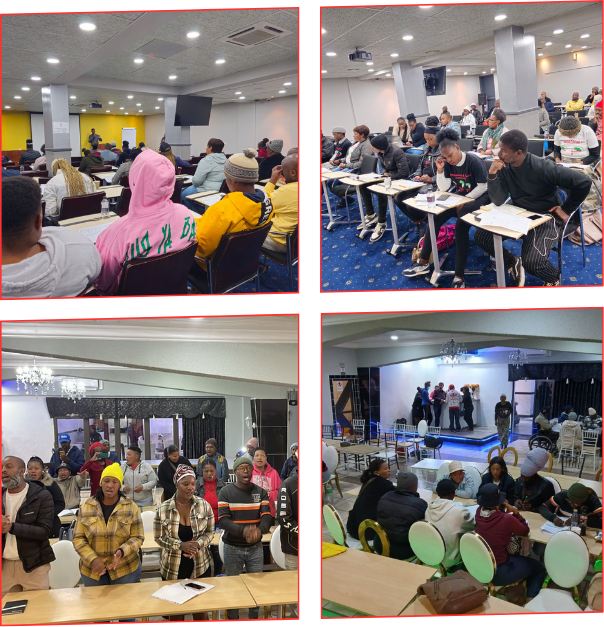
To date, two izimbizo have taken place, one in Gauteng and another in the Free State. The intention is to implement these regional imbizos throughout the nine provinces and obtain a mandate from all regions throughout the country. Consequently, it is only fitting to adhere to the principle of 'Nothing About Us, Without Us'.

Capacity building initiatives
The regional izimbizo held in Gauteng and the Free State raised critical inquiries regarding community organisation, offering valuable insights. It is essential that, in our efforts to support mining-affected communities, we extend our outreach beyond our immediate branches.
This outreach should not be limited to times when mobilising or organising for an event is necessary; rather, it should also encompass capacity-building initiatives. Ultimately, we must recognise that relying solely on legal frameworks will not suffice to advance our struggles, just as social mobilisation alone is inadequate.
However, a combination of the two, involving MACUA, partner organisations, grassroots community-based organisations, civil society groups and the wider community can yield the desired impact. To this end, MACUA has been instrumental in urging the DMPR and PCMRE to acknowledge communities as essential stakeholders who must be consulted and granted the opportunity to engage in every phase of policy formulation and legislative processes.
The emerging mandate thus far, although still in progress, is that mining licences should not be granted if the mine has not adequately fulfilled the meaningful consultation requirement. There is also a call for amendments or overhauling the Mineral and Petroleum Resources Development (MPRDA) Act of 2002, to include the principle of Free, Prior and Informed Consent (FPIC), along with a demand for the DMPR to hold mining companies accountable for non-compliance with their SLPs.
The regional izimbizo that we have conducted highlighted the necessity for grassroots organisations to be consulted, heard, and actively involved in the development of coordinated initiatives aimed at advancing the struggles of communities affected by mining activities.
Many of these grassroots organisations are established and led by individuals who reside within these communities are therefore directly affected by mining activities. Accordingly, engaging with these organisations and allowing them to spearhead their own advocacy efforts is crucial for effective community mobilisation.
The power of collective and coordinated actions
There was a dominant agreement on the importance of ongoing collective and coordinated actions to ensure accountability from mining companies. The social movements that participated in the two imbizos emphasised the importance of incorporating various sectors of society in the endeavour to advance the struggles of mining affected communities.
Numerous recommendations were made regarding the inclusion of other marginalised groups, such as LGBTQI+ individuals, persons living with disabilities, traditional healers and organisations addressing women's issues in these collaborative efforts. The importance of being inclusive is rational because it is insufficient to advocate for community involvement in critical decision-making processes while the broader groups representing these communities are excluded from our coordinated initiatives.
What also emerged was a significant focus on the necessity for community mobilisation and the adoption of innovative organising strategies. Participants highlighted the importance of conducting workshops within communities to educate ordinary members about their rights and the provisions of the MPRDA.
The discussions emphasised that organisations are currently facing challenges in mobilising communities, as they tend to engage with them primarily when seeking participation for protests and other activities. Consequently, community members remain largely uninformed about the significance of organising and leading their own efforts against the exploitation and greed of mining companies.
A combination of law and social mobilisation is necessary. MACUA and other organisations have also previously staged protests outside the courts to appeal to the judges' conscience. It is imperative that we adopt innovative strategies in our action plans. Mining corporations and the elites are often willing to resort to extreme measures, including violence, to protect their interests and profits.
As members of civil society, we must recognise that we would be at a disadvantage if we believe we can achieve victory solely through discussions in boardrooms, without sustained and coordinated grassroots efforts that remind these companies of the stakes involved.
